Intellectual Lineage
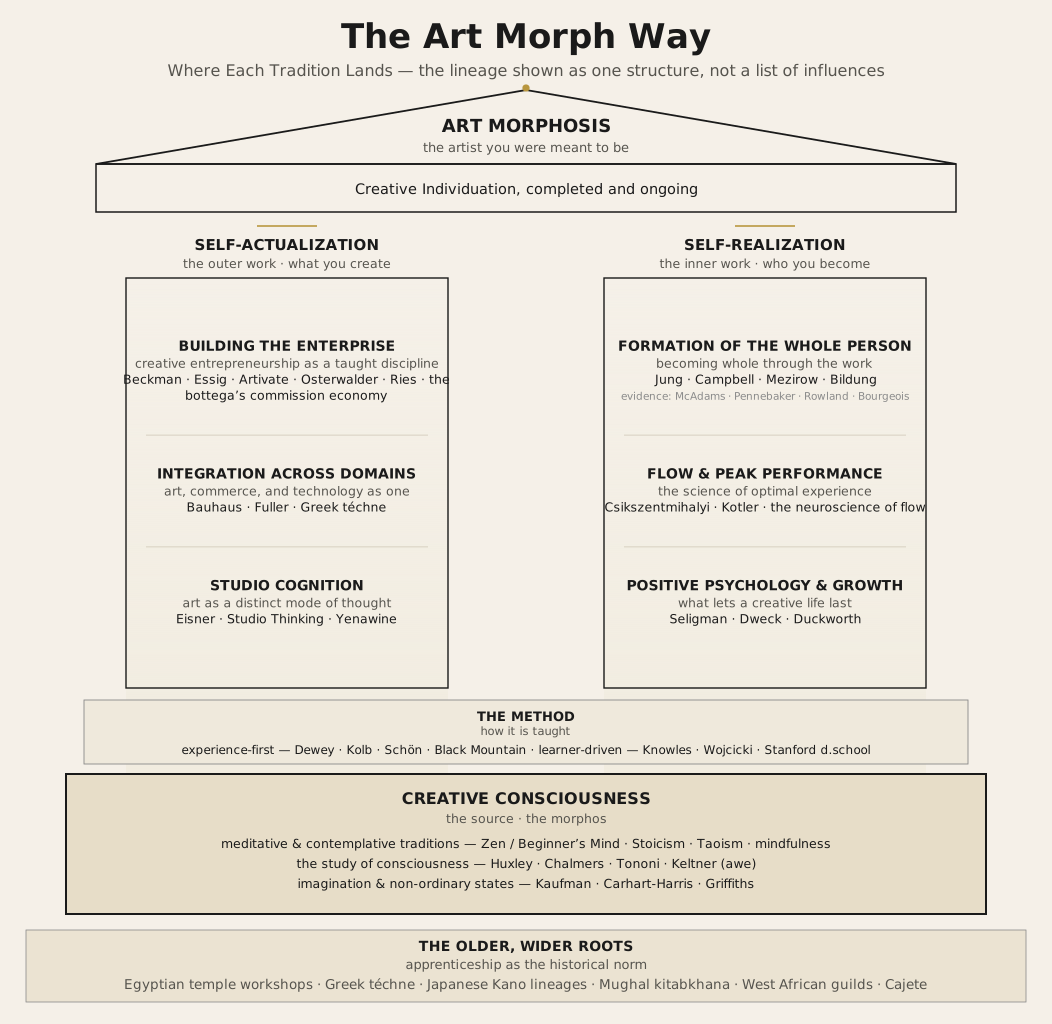
Not influences cited for credibility, but the structural foundations of an integrated model. Each tradition occupies a specific place in the architecture. What follows is why each one matters for a working artist, and the evidence behind it.
The Model We Rebuild — The Bottega
Florence, 13th–16th century
The historical foundation, and the structural argument itself. Apprentice, journeyman, master: real work for real clients under real market conditions, with art, craft, technology, commerce, and mentorship taught as one integrated practice. It produced Leonardo, Michelangelo, and Raphael, which is the historical case that integrating art with craft and commerce under real stakes deepens mastery rather than diluting it. For a graduating artist, this is the difference between a portfolio and a practice that can carry a life.
The Foundation — Creative Consciousness
the source · the morphos
The contemplative ground both pillars rest on and rise through. The meditative traditions as the disciplines of attention (Zen and Beginner's Mind, Stoicism, Taoism, mindfulness), and the modern study of consciousness: Huxley, Chalmers, and Tononi on mind; Keltner on awe and self-transcendence; Kaufman on imagination; Carhart-Harris and Griffiths on non-ordinary states. For the artist this is not metaphysics for its own sake: where production is automated, the cultivated quality of one's attention becomes the scarce and defensible source of original work. The same faculty the transformer made the engine of machine intelligence is the one these traditions have always trained: attention.
THE OUTER PILLAR
Self-Actualization
· what you create
Building the Enterprise
Beckman · Essig · Artivate · Osterwalder · Ries
Creative entrepreneurship as a taught discipline: the arts-entrepreneurship field (Gary Beckman, Linda Essig, the journal Artivate), the venture toolkit (Osterwalder's business-model design, Ries's lean practice), and the bottega's own commission economy. This is the competence whose absence strands gifted graduates, and teaching it is what turns a body of work into a livelihood. Learning to build a living from the work belongs at the core of an art education, not at its margins.
Integration Across Domains
Bauhaus · Fuller · Greek téchne
Art, commerce, and technology as one system: the Bauhaus; Fuller's comprehensivist and his principle of ephemeralization; and Greek téchne, the ancient root of the integration principle and of the word "technology" itself. The artist fluent across these domains is positioned where most new value now appears, at the seams between fields, rather than confined to a single shrinking specialty.
Studio Cognition
Eisner · Studio Thinking · Yenawine
Art as a distinct mode of thought, not a soft adjunct to the verbal disciplines: Elliot Eisner, the Studio Thinking Framework, and Visual Thinking Strategies (Yenawine). Studio Thinking's research documented eight habits of mind the studio actually trains, evidence that arts education builds transferable capacities of thought well beyond technical skill.
THE INNER PILLAR
Self-Realization
· who you become
Formation of the Whole Person
Jung · Campbell · Mezirow · Humboldt
Becoming whole through the work: Jung's individuation, Campbell's hero's journey, Mezirow's transformative learning, and the Humboldtian ideal of Bildung. The claim that the work makes the maker has empirical support: research on narrative identity and expressive writing links integrative making to measurable gains in coherence and health.
Flow & Peak Performance
Csikszentmihalyi · Kotler
The science of optimal experience: Csikszentmihalyi's flow, Steven Kotler's work on its neurology, and the neuroscience of deep attention. Flow is among the best-documented states in psychology, and teaching an artist to enter it reliably means reaching their strongest work by method rather than by luck.
Positive Psychology & Growth
Seligman · Dweck · Duckworth
What lets a creative life last: Seligman's positive psychology and PERMA, Dweck's growth mindset, and Duckworth's research on perseverance. This research shows that perseverance and a belief in one's capacity to improve predict long-term achievement, the very traits a creative career's long odds and slow returns demand.
THE METHOD
How It Is Taught
· pedagogy
Experience First
Dewey · Kolb · Schön · Black Mountain
Dewey, the epistemological root (Democracy and Education, 1916; Art as Experience, 1934); Kolb's experiential cycle; Schön's reflective practitioner; and Black Mountain College. Black Mountain is the proof: run on learning-by-doing with almost no endowment, it reshaped American art, evidence that authentic making forms artists more powerfully than instruction built for retention.
Learner Driven
Knowles · Wojcicki · Stanford d.school
Knowles's andragogy, the adult-learning contract; the moonshot classroom (Esther Wojcicki); and design thinking from the Stanford d.school. This was tested on real students before it was written: the author taught it at Design Tech High School, the first VR-and-blockchain curriculum in a U.S. public school, with students driving their own projects.
The Older, Wider Roots
Integrated, apprenticeship-based art education is the historical norm, not a Renaissance peculiarity: Egyptian temple workshops, Greek téchne, Tang scholar-painter studios, Japanese Kano lineages, Mughal kitabkhana ateliers, West African sculpture guilds, and Cajete's ecology of Indigenous education. That so many cultures arrived at it independently is itself the argument: integration is the rule across history, and the separated academy the exception the Art Morph Way exists to correct.
What It Acts Like
Comparison to existing frameworks — where the Art Morph Way overlaps, and where it diverges.
Project-Based Learning
Kilpatrick 1918; Markham 2011
Project-based learning organizes study around a real task rather than a syllabus, making the work itself the engine of learning. The Art Morph Way embeds it fully but at professional stakes: the "project" is an actual creative enterprise with real revenue, real clients, and real market feedback, not the rehearsal version most programs can offer.
Experiential Learning Cycle
Kolb 1984
Kolb formalized learning as a four-stage cycle, knowledge made by acting and then reflecting. The Art Morph Way's four-part architecture runs directly on it: Concrete Experience → Reflective Observation → Abstract Conceptualization → Active Experimentation, extended across an entire creative life rather than a single lesson.
Studio Thinking Framework
Hetland et al., 2013
Studio Thinking named the eight habits of mind a studio actually trains, establishing art as a distinct mode of cognition rather than a soft skill. The Art Morph Way develops all eight throughout and extends them into the territory art education usually cedes: commerce, technology, and the AI-disrupted marketplace.
Design Thinking / Moonshot Classroom
Stanford d.school; Wojcicki
Design thinking and the moonshot classroom hand the agenda to the learner, a transdisciplinary process and the student's own project driving the curriculum. Here the framework is not cited but lived: Brink trained as a moonshot educator under Esther Wojcicki and built it at Design Tech High School, the first VR-and-blockchain curriculum in a U.S. public school.
Arts Entrepreneurship Education
NAEA, AAAE; Essig, Chang, Betzler
A maturing field has built entrepreneurship courses and curricula inside art schools, with its own associations and scholarship. The Art Morph Way respects these efforts and goes further: adding an entrepreneurship track to the MFA is insufficient when the operating system beneath it, the separation of art from commerce, is the thing that needs replacing.
Art & Creative Economics
Florida 2002; Throsby 2001; Abbing 2002
This field maps the creative economy. The Art Morph Way teaches economic fluency, including the artist's own personal behavioral economics: compounding, pricing, revenue, and the practical work of making a living, empowering artists to form their own personal economic operating system in response to politically controlled economic realities.
Science of Creativity & Flow
Csikszentmihalyi 1990; Amabile 1996; Sawyer 2006; Kotler 2014
This research maps how creativity and flow actually work, from the conditions that spark ideas to the neurology of deep absorption. The Art Morph Way turns that description into daily practice, with the Field Companion's Performance Protocols built to put artists into the states the science identifies.
Positive Psychology & Well-Being
Seligman 2011; Fredrickson 2009; Dweck 2006; Duckworth 2016
Positive psychology studies the conditions of flourishing in general, from well-being to resilience to growth. The Art Morph Way aims it at the specific conditions of a creative life (its long odds, slow returns, and high attrition), making resilience and growth a taught part of the curriculum rather than a matter of temperament.
Transformative Learning & Depth Psychology
Mezirow 1991; Jung, Collected Works; Campbell 1949
Transformative learning describes how adults change their frame of reference; depth psychology describes individuation, the integration of the self. The Art Morph Way joins both to the working life, arguing that the building of a practice is the medium through which that inner change actually happens.
Consciousness Research
Chalmers 1996; Tononi 2012; Metzinger 2003; Huxley 1954
The science of mind treats consciousness as an object of study, from the hard problem to theories of how it arises. The Art Morph Way treats creative consciousness as the trainable ground of the practice, the scarce faculty that survives automation, borrowing the rigor without mistaking a theory of consciousness for the cultivation of it.
Contemplative Education
Kabat-Zinn 1994; Barbezat & Bush 2014; Center for Contemplative Mind in Society
Contemplative pedagogy has brought mindfulness into the university, usually as a tool for focus and student well-being. The Art Morph Way makes contemplative practice foundational to the creative method itself, the source of attention and vision, not a wellness supplement bolted to the side.