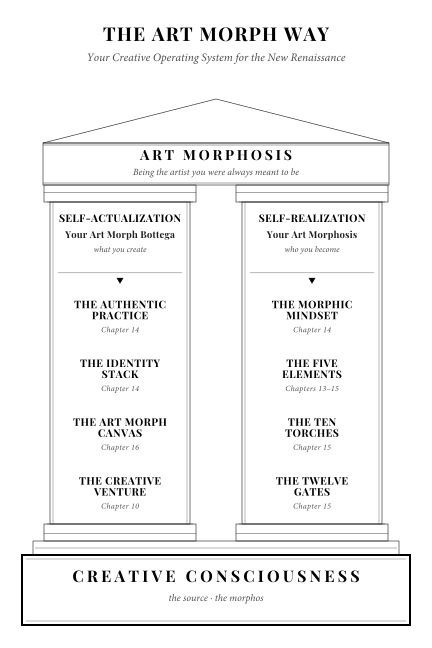
The Art Morph Way begins with three truths. Everything else grows from them.
Three Arguments
Creative Consciousness
At the heart of the Art Morph Way is Creative Consciousness — the principle that creativity is not merely a skill or talent, but an integral part of our very being. A boundless source of creative energy that propels us toward adaptation, innovation, and our highest creative potential.
The Art Morph Way cultivates this through a blend of ancient wisdom — meditation, mindfulness, self-awareness — and modern neuroscience, positive psychology, and metacognitive techniques.
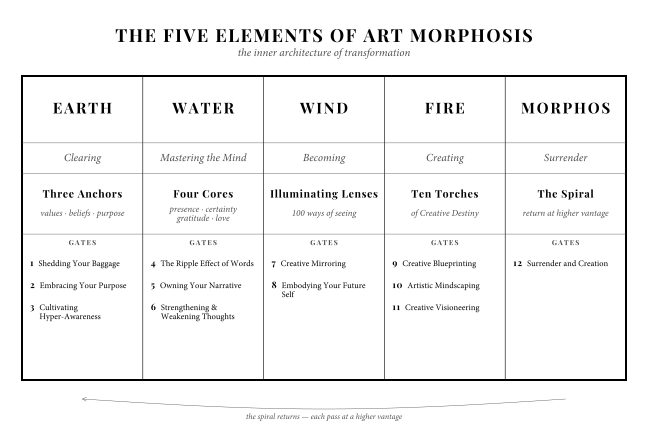
Art Morphosis: The Five Elements
Art Morphosis is not a metaphor. It is a structured journey through five states of creative being — each one a door the others cannot open.
The Art Morphosis methodology draws upon the five classical elements — Earth, Water, Wind, Fire, and Morphos — as the framework for your transformational journey.
EARTH
Grounding Your Transformation
Values, beliefs, and purpose. The three anchors that hold you steady.
WATER
The Four Cores of Creative Being
Creative Presence, Creative Certainty, Creative Gratitude, and Creative Love.
WIND
Expanding How You See
The multiplication of perspectives. The 100 Illuminating Lenses. Beginner's Mind.
FIRE
The Ten Torches of Creative Destiny
Purpose Ignited, Fear Consumed, and eight more fires that forge the artist you are becoming.
MORPHOS
The Gates of Art Morphosis
The creative substrate of the cosmos. The 12 Gates — where the deepest transformation happens.
Intellectual Lineage
The Art Morph Way is grounded in a deep lineage of sources — not influences cited for credibility, but the structural foundations the framework is built upon.
The Bottega Tradition
Florence, 13th–16th c.
The structural argument. Art, commerce, craft, and mentorship as a single integrated system.
John Dewey
1916–1934
The epistemological foundation. Learning through experience and authentic making.
R. Buckminster Fuller
1948–1975
The cognitive model. The comprehensivist who synthesizes across domains.
Malcolm Knowles
1968–1973
The pedagogical contract. Five principles of andragogy.
Arts Entrepreneurship
Essig & Beckman, 21st c.
The economic discipline. Building a living from the work as part of the craft.
Elliot Eisner & Studio Thinking
2002–2013
The studio's cognition. Art as a distinct mode of thought.
Carl Jung
1921–1961
The depth-psychological model. Individuation, the making of a whole self.
Mihaly Csikszentmihalyi
1975–1990
The performance science. Flow, the state of optimal creative work.
Martin Seligman
1998–2011
The science of flourishing. Positive psychology and what lets a practice last.
The Contemplative Traditions
Ancient–present
The attentional ground. The disciplines of attention: Zen, Stoicism, Taoism, mindfulness.
Consciousness Research
Chalmers & Tononi, 20th–21st c.
The study of mind. Creative consciousness as the trainable source.
The Older, Wider Roots
Egypt to West Africa
The cross-cultural precedent. Integrated apprenticeship as the historical norm.
Steer your creative life in the computational age.
For roughly four hundred years, the most effective training the West ever produced for an artist was the bottega — the Renaissance workshop, where a master set the vision and a studio of hands carried it out. It trained Leonardo, Michelangelo, Botticelli. Then the academy kept the lectures and let the workshop go.
The Art Morph Way brings the workshop back, with one change that changes everything. You are not the apprentice. You are the master.
One artist. A workshop that never sleeps.
The work that once demanded a studio of apprentices, a payroll, and a large budget is now done by AI, and you direct it. A solo founder can conduct the output of an entire art factory: ten million Da Vincis worth of capable hands, with no ceiling and no overhead. What you supply is the one thing the machine cannot — the vision worth making, and the judgment to aim a tireless workforce at it.
That is the whole shift: the bottega's structure, with its labor inverted and its ceiling removed.
Grounded in how the field actually teaches
The Art Morph Way is not a manifesto. It gathers the most durable findings in education into one working method and names them, because these are the terms a serious educator recognizes on sight.
A signature pedagogy
Every profession has a characteristic way it forms its practitioners: the case method in law, rounds in medicine, the studio in architecture. Art's was the bottega. The Atlas restores it, with the artist as master from the first day.
Self-determined learning
Past the adult-learning model of andragogy lies heutagogy, where the learner sets the course instead of following one. The solo art-founder is that learner in full: deciding what to make, and directing a moonshot art factory, their own entrepreneurial enterprise.
Threshold concepts
Some ideas, once crossed, change you for good. The Atlas is built to carry you across one — a shift in how you understand your creative identity, your practice, and your economic position that cannot be un-crossed.
Creative individuation
The point is not what you remember but who you become. Drawing on Jung's individuation and Mezirow's transformative learning, the Atlas moves you toward Art Morphosis — your Transformative Artistic Purpose made real, where what you build and who you become rise together.
Constructive alignment
A curriculum works when its goals, its practice, and its assessment all answer to one another. The three volumes are built to that standard: the Atlas to teach, the Workbook to practice, the Field Companion to reference.
The master and the apprentice
Every classic account of expertise puts the learner at the bottom, climbing under a master for years before the real work begins. The Art Morph Way starts you at the top. Superintelligence becomes both mentor and workforce from day one, absorbing the overhead that once consumed a practice. The vision and the direction stay yours.
Train the way the Renaissance trained. Command the workshop it never had.
FOR UNIVERSITIES & INSTITUTIONS
Bring Art Morphosis to your program
Integration through executive workshops for deans, faculty development seminars, and the Art Morph Lab for curriculum innovation.